Why Horse Owners Choose VetOne Vetrimec Ivermectin Paste for Deworming
This post may contain affiliate links. Please read ourdisclosure policy
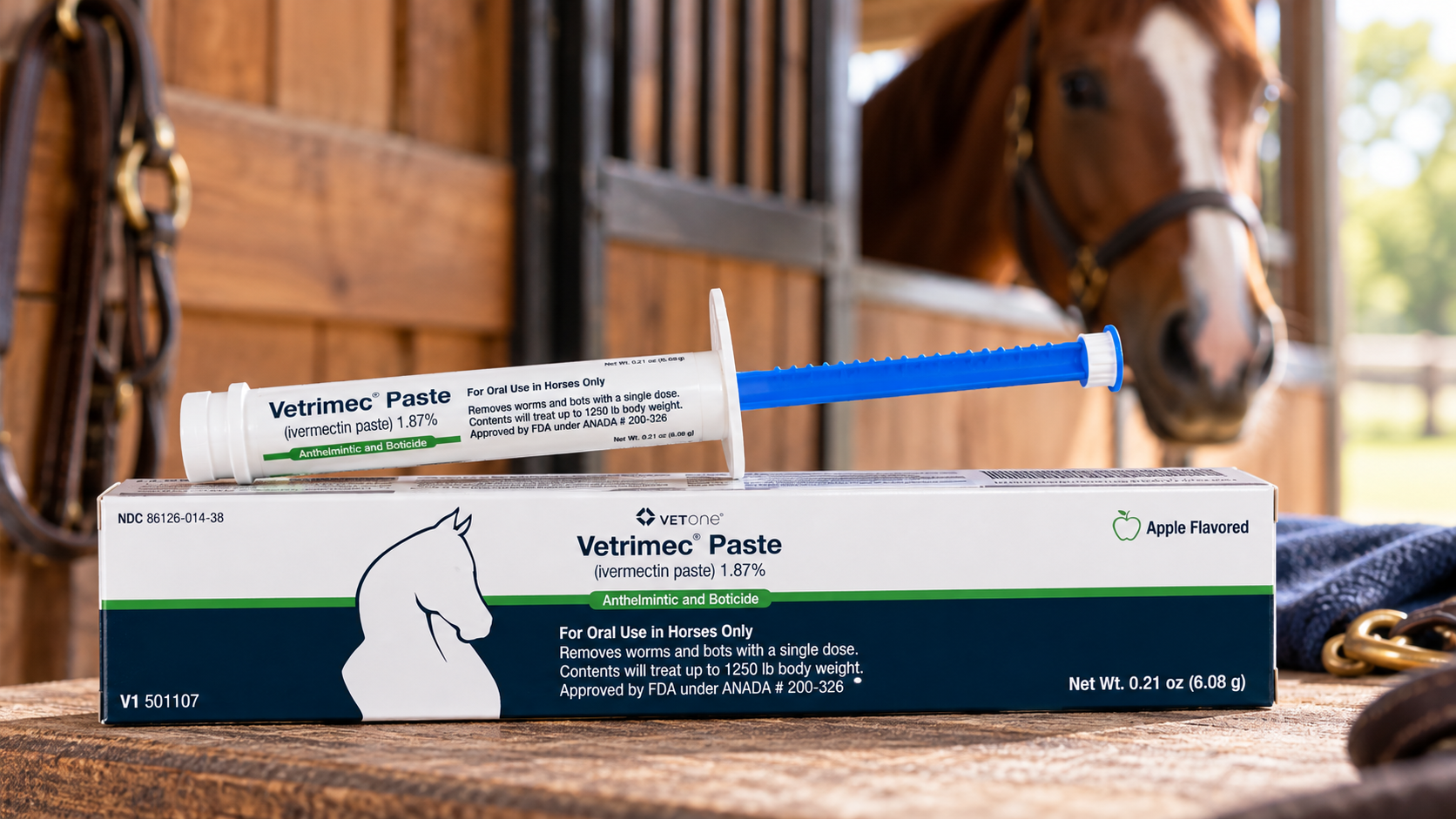
Choosing a dewormer requires checking the active ingredient, parasite coverage, dosage format, and suitability for your horse. VetOne Vetrimec Ivermectin Paste is an oral equine dewormer containing 1.87% ivermectin.
One 6.08-gram syringe contains enough paste to treat a horse weighing up to 1,250 pounds when administered according to the product label. Before adding it to your parasite-control routine, you should understand what it treats, how the syringe works, and why accurate body weight matters.
What Is VetOne Vetrimec Ivermectin Paste?
VetOne Vetrimec Ivermectin Paste is an anthelmintic and boticide labeled for oral use in horses. Its active ingredient is ivermectin at a concentration of 1.87%.
As an ivermectin paste for horses, it treats and controls several internal parasites and bots covered by its approved label. These include large and small strongyles, pinworms, ascarids, hairworms, lungworms, intestinal threadworms, large-mouth stomach worms, and oral and gastric stages of bots.
The product is supplied in a calibrated oral syringe. A full syringe treats up to 1,250 pounds of body weight at the labeled ivermectin dosage of 200 mcg/kg.
Key Product Details
Here are the main specifications you should check before purchasing:
- Active ingredient: Ivermectin 1.87%
- Product type: Anthelmintic and boticide
- Form: Oral paste
- Species: Horses only
- Package size: 6.08 g (0.21 oz) syringe
- Maximum weight treated per syringe: 1,250 lb
- Syringe increments: Each weight marking treats 250 lb of body weight
- Recommended dose: 200 mcg ivermectin/kg of body weight
- Storage: 68°F to 77°F (20°C to 25°C), with permitted excursions from 59°F to 86°F (15°C to 30°C)
- Important restriction: Do not use in horses intended for human consumption
These specifications make it relatively simple to compare Vetrimec with another horse dewormer paste before purchasing.
What Parasites Does Vetrimec Treat?
Parasite coverage is one of the main factors to check when comparing equine dewormers. According to its approved labeling, Vetrimec treats or controls several parasite groups.
These include:
- Large strongyles
- Adult small strongyles and fourth-stage larvae
- Pinworms
- Ascarids or roundworms
- Hairworms
- Large-mouth stomach worms
- Lungworms
- Intestinal threadworms
- Oral and gastric bot stages
- Certain larvae associated with summer sores
- Neck threadworm microfilariae associated with dermatitis
The range of labeled parasites makes Vetrimec a broad-spectrum horse dewormer, though no single deworming medication should be expected to address every parasite or every parasitic stage a horse may encounter.
How Does the Dosing Syringe Work?
Correct dosing matters when using any ivermectin horse dewormer. The Vetrimec syringe has weight markings that let you adjust the dose according to your horse's current body weight.
Each marking represents enough medication for 250 pounds of body weight. The entire syringe provides enough medication for a horse weighing up to 1,250 pounds.
The label directs you to adjust and lock the dosing ring at the correct weight marking. Your horse's mouth should be free of feed before administration.
The syringe tip is then placed into the space between the teeth, and the paste is deposited toward the back of the tongue. After administration, the horse's head should be raised briefly to encourage swallowing.
Accurate weight estimation is important. Underdosing may reduce treatment effectiveness and contribute to parasite resistance.
Is Vetrimec Suitable for Foals, Mares, and Stallions?
The product label states that Vetrimec may be used in horses of all ages, including mares at any stage of pregnancy. Stallions can also be treated without adversely affecting fertility according to the label.
For foals, the manufacturer's parasite-control information states that initial treatment should begin at approximately six to eight weeks of age, followed by treatment as appropriate. Age alone should not determine your entire deworming schedule.
Your veterinarian can help establish an equine parasite control program based on age, management conditions, exposure, fecal testing, and parasite risks at your barn or property.
Should You Deworm Horses on a Fixed Schedule?
Current equine parasite-management guidance favors targeted treatment rather than automatically giving every horse a dewormer at short, fixed intervals throughout the year. The American Association of Equine Practitioners recommends using fecal egg counts to categorize horses according to parasite egg shedding.
It also recommends periodic fecal egg count reduction testing to check if the dewormers being used remain effective. That means your horse worm treatment plan may depend on factors such as:
- Your horse's age
- Fecal egg count results
- Previous parasite history
- Local climate and transmission season
- Pasture management
- Number of horses sharing grazing areas
- Effectiveness of previously used dewormers
A veterinarian can help determine when ivermectin fits your horse's individual parasite-management plan.
What Should You Check Before Buying?
Price should not be your only comparison point. Before purchasing Vetrimec, check several practical factors.
Confirm the active ingredient
Vetrimec contains 1.87% ivermectin. If your veterinarian recommends a different dewormer class for the parasites affecting your horse, another product may be appropriate.
Know your horse's weight
Because the syringe is calibrated according to body weight, having an accurate current weight helps prevent underdosing.
Check the parasite-control plan
Repeatedly administering the same product without testing can contribute to ineffective parasite management. Fecal egg counts and veterinary guidance can help you determine which horses actually require additional treatment.
Check the package
Confirm that the syringe is sealed, within its expiration date, and stored according to the manufacturer's instructions.
Compare the cost per treatment
One syringe treats up to 1,250 pounds. When comparing prices with competing ivermectin products, compare the active ingredient concentration, syringe capacity, labeled weight coverage, and seller rather than looking only at the package price.
Safety Information You Should Know
Vetrimec is formulated specifically for horses. The label warns against using the product in other animal species because serious adverse reactions can occur, including fatalities in dogs.
The product is not approved for human use. It should also never be used in horses intended for human consumption.
Some horses with heavy neck threadworm microfilariae infections may experience swelling or itching after treatment as large numbers of microfilariae die. Veterinary attention may be needed if a reaction develops.
Keep the medication away from children, avoid eye contact, wash your hands after handling it, and follow all package instructions.
How Does Vetrimec Compare With Similar Products?
Vetrimec competes with several equine products containing ivermectin 1.87%. Because products with the same active ingredient and concentration may have similar parasite indications, your comparison may come down to syringe design, availability, price, expiration date, and veterinary recommendations.
You should still read the individual label rather than assuming that two products have identical instructions. A lower price can be useful when the active ingredient and labeled use fit your horse's parasite-management plan.
However, selecting a dewormer based only on cost may not address resistance patterns or the parasites currently affecting your horse.
Frequently Asked Questions
How much ivermectin does Vetrimec contain?
Vetrimec Paste contains 1.87% ivermectin, equivalent to 18.7 mg of ivermectin per gram of paste.
How much weight does one syringe treat?
One 6.08-gram syringe contains enough medication to treat up to 1,250 pounds of horse body weight at the labeled dose.
Can Vetrimec be given to pregnant mares?
Yes. According to the product label, it may be used in mares at any stage of pregnancy.
Does Vetrimec treat bots?
Yes. Its labeled indications include oral and gastric stages of Gasterophilus bot species.
Can you give Vetrimec to dogs?
No. Vetrimec Paste is formulated for horses only. Its label specifically warns that use in other animal species can cause severe adverse reactions, including fatalities in dogs.
Does every horse need the same deworming schedule?
No. Current equine parasite-control recommendations support using factors such as fecal egg counts, age, parasite exposure, and treatment effectiveness to guide deworming decisions.
Is VetOne Vetrimec Ivermectin Paste Worth Buying?
VetOne Vetrimec Ivermectin Paste can be a practical option when ivermectin is appropriate for your horse's parasite-control program. You get 1.87% ivermectin in a calibrated 6.08-gram syringe capable of treating up to 1,250 pounds.
Its labeled parasite coverage includes several common equine internal parasites and bots, while the adjustable syringe supports weight-based dosing. Before purchasing, confirm that ivermectin fits your horse's current parasite-management needs.
Accurate body weight, fecal testing, local resistance patterns, and veterinary guidance can help you use dewormers responsibly and avoid unnecessary treatment.