What Shopify Conversion Optimization Means for Growing Ecommerce Stores
This post may contain affiliate links. Please read ourdisclosure policy
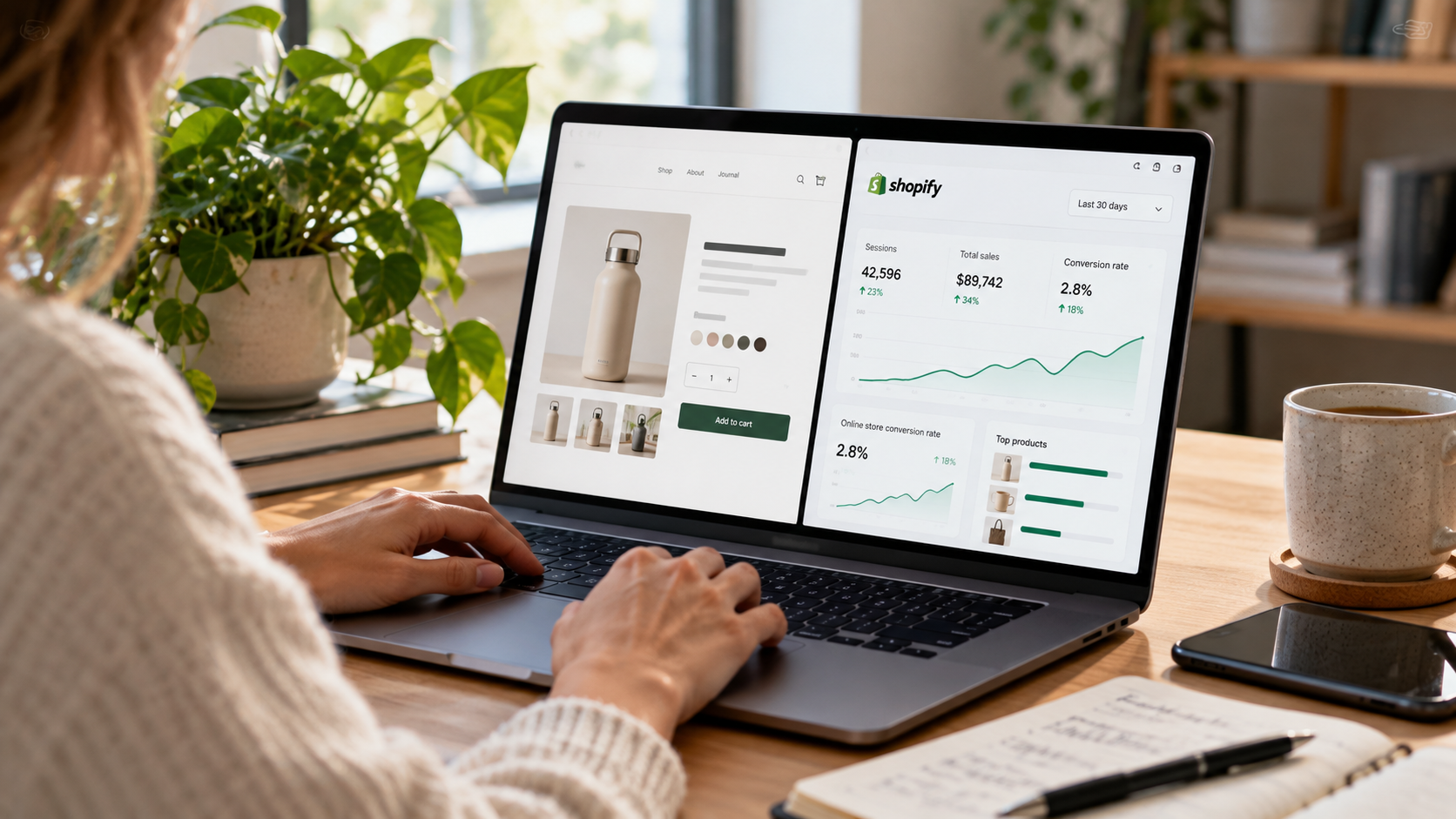
Getting shoppers to visit an online store is only part of running an ecommerce business. The next challenge is turning those visits into meaningful actions.
Shopify conversion optimization focuses on improving store elements that influence purchases, add-to-cart actions, checkout completion, subscriptions, and other conversion goals. Shopify does not sell a standalone conversion rate optimization product.
Instead, merchants can use its storefront, checkout, Shop Pay, analytics, merchandising features, and compatible third-party applications to build a conversion optimization strategy. Depending on the size of your store, this approach can range from basic page improvements to advanced A/B testing and personalization.
How Shopify Conversion Optimization Works
Shopify conversion optimization starts by identifying points where visitors hesitate, leave, or encounter unnecessary friction.
A typical customer may arrive through an advertisement or search result, visit a collection page, open a product page, add an item to the cart, and proceed through checkout. Each part of that process can affect conversion performance.
Optimization may involve improving product descriptions, adjusting calls to action, simplifying navigation, testing page designs, clarifying shipping information, improving mobile usability, or examining checkout behavior.
The objective is not always to produce the highest possible conversion rate. A successful strategy should account for revenue, average order value, customer acquisition costs, and profitability.
Shopify Pricing and CRO Costs
Shopify pricing creates the base cost of running the store. Based on the supplied U.S. pricing, monthly plans include:
- Basic: $39 per month
- Grow: $105 per month
- Advanced: $399 per month
- Shopify Plus: starting at $2,300 per month
Annual billing can lower the effective monthly cost. Basic comes to approximately $29 per month, Grow to $79 per month, and Advanced to $299 per month when billed annually. CRO software may create an additional monthly expense.
Professional testing applications can start around $99 per month and reach $999 per month for higher-level plans. Pricing can change and may differ by market, so merchants should verify current Shopify and application pricing before subscribing.
Start With the Product Page
Product pages are among the strongest places to begin optimization because shoppers use them to decide if an item fits their needs. Clear product titles and descriptions can help customers understand exactly what they are buying. High-quality images and videos can provide visual information that written descriptions cannot communicate as quickly.
Product pages may also benefit from clearly displayed pricing, variant selectors, shipping details, return information, customer reviews, ratings, product recommendations, and visible add-to-cart controls. Avoid filling the page with unnecessary sales messages. Too many competing elements can distract visitors from the primary purchase action.
Improve the Checkout Experience
A shopper reaching checkout has already demonstrated significant purchase intent. Friction at this stage can therefore have a direct effect on completed orders. Shopify provides a mobile-friendly checkout system and supports several payment methods.
Shop Pay can speed up purchases for eligible returning customers by storing relevant checkout information securely for future transactions. Merchants should examine checkout initiation and completion rates to identify potential problems.
Unexpected shipping charges, unclear delivery information, limited payment choices, and unnecessary distractions may cause shoppers to reconsider an order. Some advanced checkout testing and customization capabilities depend on the Shopify plan and third-party application being used. Certain functionality may require Shopify Plus.
Optimize the Store for Mobile Shoppers
Mobile optimization should receive dedicated attention rather than being treated as a smaller version of desktop design. Check how quickly important information becomes visible on a phone.
Product photos, pricing, variant controls, add-to-cart buttons, navigation, search, and checkout elements should remain easy to use on smaller screens. Large image files, crowded layouts, intrusive pop-ups, or poorly positioned buttons can create unnecessary barriers.
Testing mobile and desktop performance separately can help merchants determine if one device category has a noticeably weaker conversion rate.
Use A/B Testing to Compare Changes
A/B testing allows merchants to compare different versions of a page or element using actual visitor behavior. For example, a store could test two product-page layouts to see which produces a stronger add-to-cart rate.
Other experiments may compare headlines, product imagery, page templates, calls to action, shipping thresholds, navigation designs, promotional messages, or landing pages. Dedicated Shopify CRO applications provide testing capabilities beyond standard store analytics.
Shoplift starts at $99 per month for its Core plan, while its Advanced and Pro plans cost $399 and $999 per month respectively based on the supplied pricing. ABConvert starts at $99 per month for Starter, with Growth priced at $199 per month.
GemX Funnel Optimize pricing ranges from $99 to $699 per month depending on sitewide revenue. These applications vary in testing methods, usage limits, integrations, targeting, and supported experiments.
Track Metrics That Affect Business Results
Conversion rate is useful, yet relying on it alone can create misleading conclusions. Suppose a store heavily discounts a product and its conversion rate increases.
The test may appear successful at first. If margins fall sharply, however, the business may earn less profit despite receiving additional orders. Useful CRO measurements include:
- Conversion rate
- Add-to-cart rate
- Checkout initiation rate
- Checkout completion rate
- Cart abandonment rate
- Average order value
- Revenue per visitor
- Customer acquisition cost
- Customer lifetime value
- Profit per visitor
Revenue per visitor can be especially helpful when comparing experiments that influence both conversion rates and order values.
Test Pricing and Promotional Strategies Carefully
Advanced CRO platforms may allow stores to experiment with product prices, discounts, shipping thresholds, promotional structures, and other commercial variables. Price testing requires careful interpretation. Increasing conversions through aggressive discounts does not automatically improve business performance.
Merchants should evaluate revenue, margins, transaction costs, product costs, shipping expenses, and customer behavior before declaring a pricing experiment successful. Testing should answer a specific business question rather than changing several variables without a clear hypothesis.
Use Audience Segmentation
Visitors do not always behave the same way. A customer arriving from a paid social advertisement may behave differently from someone searching for a specific product on Google.
New visitors may respond differently from returning customers, while mobile behavior may differ considerably from desktop behavior. Some CRO platforms support segmentation based on device, traffic source, customer type, location, or behavioral characteristics.
Segmentation can help determine which version of an experience performs better for a particular visitor group. Advanced tools can use those findings to support personalized store experiences.
Improve Landing Pages and Homepages
Landing pages should quickly communicate what the visitor can do next.
Clear headlines, relevant imagery, straightforward calls to action, logical navigation, and carefully selected products can help visitors understand the page without unnecessary searching. Homepage optimization follows similar principles.
Merchants should examine banners, featured products, collection links, navigation menus, promotional content, testimonials, and mobile layouts. Every element should have a clear function. Removing unnecessary distractions can sometimes be as useful as adding new features.
Use AI-Assisted CRO Carefully
CRO applications increasingly include AI-assisted capabilities for generating experiment ideas, identifying possible opportunities, creating variations, or analyzing results. These features can reduce some of the manual work involved in developing experiments.
They cannot compensate for insufficient traffic, poorly designed tests, unreliable data, or weak business assumptions. Human review remains important when deciding which experiments deserve attention and how results should influence the store.
How Much Can a Shopify CRO Setup Cost?
The total expense depends heavily on the level of experimentation required. A Shopify Basic subscription combined with Shoplift Core would cost approximately $138 per month using the supplied monthly pricing. Shopify Grow with Shoplift Core would cost approximately $204 per month.
A higher-level configuration using Shopify Advanced and Shoplift Advanced would reach approximately $798 per month. At the enterprise level, Shopify Plus combined with Shoplift Advanced starts around $2,699 per month. Pairing Shopify Plus with Shoplift Pro starts around $3,299 per month.
These figures exclude payment processing, advertising, development, premium themes, and other applications. Stores do not necessarily need paid CRO software immediately.
New businesses can first improve product information, navigation, mobile usability, checkout clarity, site performance, and basic analytics before investing heavily in experimentation software.
When Advanced CRO Software Makes Sense
Paid testing platforms tend to become increasingly useful as stores generate enough traffic and transactions to support meaningful experiments. A low-traffic store may struggle to collect enough data to distinguish an actual improvement from normal variation.
In that situation, basic usability improvements and customer research may provide greater value than expensive testing software. Higher-traffic stores have additional opportunities.
Even relatively small improvements in revenue per visitor can affect overall revenue when applied across a large number of sessions.
Choosing the Right Shopify Conversion Optimization Strategy
Shopify provides a strong ecommerce foundation for merchants interested in conversion optimization. Its storefront tools, checkout, Shop Pay, analytics, merchandising capabilities, and third-party application ecosystem give businesses several ways to improve the buying process.
The right CRO strategy depends on store traffic, revenue, customer behavior, available resources, and business goals. Smaller stores can begin with page clarity, mobile usability, product information, and checkout improvements.
Growing stores can introduce structured A/B testing as traffic increases. Advanced applications add price testing, segmentation, personalization, theme experiments, and detailed performance analysis, though these capabilities increase monthly costs.
The strongest Shopify conversion optimization programs focus on measurable business results rather than conversion rate alone. Tracking revenue per visitor, average order value, acquisition costs, and profitability alongside conversions can help merchants make decisions that support sustainable ecommerce performance.